Start with shape and length
Before steel, before brand, before the Damascus pattern, decide the shape and length, because that is what you feel every single time you pick the knife up. For most kitchens the choice comes down to two blades. A gyuto is the Japanese chef's knife, usually 200 to 240 mm, with a slightly flatter profile than a Western blade that rewards push-cutting; it is the versatile all-rounder. A santoku is shorter and flatter, typically 165 to 180 mm, with a rounded sheepsfoot tip built for straight up-and-down cuts; it is more nimble and easier to learn.
As a rule of thumb, a confident cook in an average kitchen wants a 200 to 210 mm gyuto, such as the Shun Classic or the Tojiro DP. Someone with smaller hands, a smaller board, or buying their first Japanese knife is usually happier with a 165 mm santoku like the 128 g Kai Wasabi. And if you do a lot of heavy batch prep, a deliberately heavy 200 mm gyuto like the 221 g Yaxell Ran carries the momentum to power through dense produce. We go deeper in our gyuto vs santoku guide.
Steel and hardness (the HRC number)
Hardness is measured on the Rockwell C scale (HRC), and most good Japanese kitchen knives sit between 58 and 63 HRC, against around 56 HRC for a German knife. That band hides a genuine trade-off, and there is no single best figure:
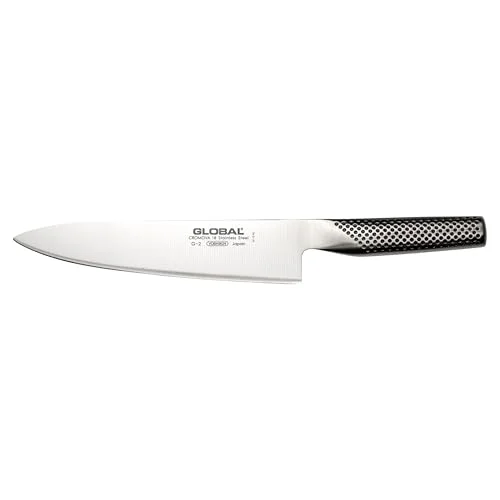
- Around 57 to 58 HRC (the Global G-2, Kai Wasabi) is more forgiving, more chip-resistant and quick to re-sharpen, about four to five minutes on a stone. The edge dulls a little sooner.
- 60 to 61 HRC (the Tojiro, Shun, Yaxell) is the sweet spot of edge retention and toughness, holding a working edge for six to ten weeks of daily use. This is where most cooks should look.
- 63 HRC (the Miyabi SG2) holds an edge longest, three to four months in our testing, and takes the finest edge of all, but it is more brittle and demands careful sharpening.
You will see steel names like VG10, VG-MAX, CROMOVA 18 and SG2. These are all stainless cutlery steels, so none of these knives rust in normal use, though a bare core spine can show a harmless grey patina if left wet. The Damascus pattern on the Shun, Miyabi and Yaxell is the visible cladding around the cutting core; it looks lovely and hides scratches but does not change how the knife cuts. Pay for the right core steel and hardness, not for the number of layers.
Edge angle: the spec almost nobody checks
The edge angle decides how keenly a knife cuts and how durable that edge is. A narrower angle slices more finely but is more fragile. The knives here run from a very fine 9.5 degrees per side on the Miyabi, through 15 degrees on the Global, Tojiro and Yaxell, to 16 degrees on the Shun and Kai. Anything in the 15 to 16 degree range is a sensible, durable everyday edge; the Miyabi's 9.5 degrees is a precision edge for a careful owner. This matters practically because when you sharpen you match the factory angle on the stone, which is precisely why a pull-through sharpener (fixed near 20 degrees) ruins a Japanese edge: it grinds the wrong angle and tears the thin steel.
Handle and balance
The handle and bolster decide how the knife feels and where its weight sits. A traditional Japanese (wa) handle is light and shifts balance towards the blade; a Western (yo) handle with a full bolster, like the Yaxell's, adds weight at the heel for a chopping-forward feel. Weight matters more than people expect: our lightest blade is 170 g, our heaviest 221 g, a 51 g gap you feel within minutes over a big prep session. A light knife flatters fine, fast work; a heavy one does the work for you on dense veg. Grip texture matters too, the Global's smooth metal can slip when wet where the Yaxell's Micarta stays secure, and left-handers should check whether a knife's handle, like the Shun's D-shape, is contoured for the right hand.
Care and sharpening
A Japanese knife rewards a little care, and the rules are short. Hand-wash and dry it straight after use, never the dishwasher. Cut on wood or soft plastic, never glass, stone or worktop, which chip and roll a hard edge. Avoid bone, frozen food and twisting in a hard squash, all of which can chip 60-plus HRC steel. And learn to use a whetstone: a basic 1000/6000-grit combination stone costs around £30 and, with ten minutes of practice, keeps any knife on this list scary-sharp for years. Do those few things and a £65 Tojiro will outlast a whole drawer of supermarket knives. Our sharpening guide walks through the angle and the technique step by step.